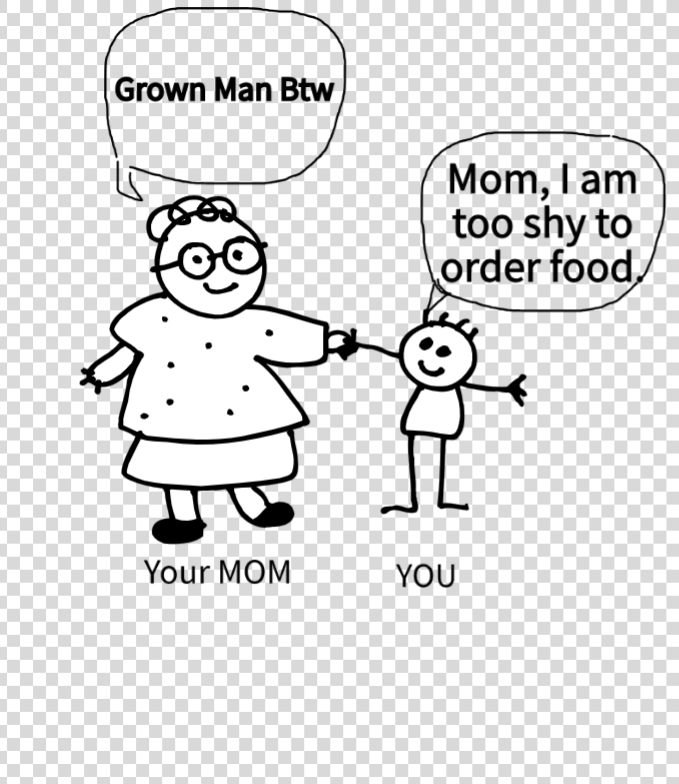
Grown Man cannot order food for himself?!
Learning concepts of Load Balancing by the example of this GROWN MAN too shy to order his own food...like bro, lock in 😭😭😭
Too Shy to Order Food? Let’s Talk About Proxies and Load Balancing
You’re at a restaurant, but you’re too shy to order food yourself. So, you ask your mom to do it for you. She talks to the waiter, and the waiter finds you a table.
In this story:
You = Client (computer)
Mom = Proxy (Forward)
Waiter = Proxy (Reverse) talking to the Servers
Table = Server
This is how proxies work in networking. They act as a middleman, handling communication on your behalf.
And today, in our SD Basics series by TANICE, we’ll explore how proxies help with Load Balancing.
What is Load Balancing?
As the name suggests, load balancing is all about distributing the load>>making sure no single server gets overwhelmed while others sit idle.
Back to our restaurant analogy:
You (the client) want to be seated.
The waiter (proxy) decides which table (server) you’ll go to.
The decision can be made in several ways.
Methods of Load Balancing
1. Random
The waiter assigns tables randomly. No logic, just chance.
2. Round Robin
Tables are numbered 1 to 5.
First customer >> Table 1
Second customer >> Table 2
Third customer >> Table 3
…and so on.
Every table gets a fair turn. (1/nth probability.)
3. Weighted Round Robin
Not all tables are equal. Some are bigger, stronger, or more capable.
Table 1 can seat 2 people.
Table 2 can seat only 1.
So, the waiter sends two customers to Table 1, then one to Table 2, and repeats.
This way, servers are assigned based on their capacity to handle stress.
4. Least Loaded
The waiter looks around and sends you to the table with the fewest people already seated.
This ensures no table gets overcrowded while others remain empty.
5. Layer 4
Works at the transport layer (think: basic traffic rules).
Decides where to send requests by looking at things like:
Source IP address
Destination IP address
Port numbers
It does not look inside the actual data.
It simply forwards packets between client and server using something called NAT (Network Address Translation).
Example: A guard at a parking lot who only checks your car’s license plate and lane number, not what’s inside the car.
6. Layer 7
Works at the application layer (think: reading the actual request).
Can look at:
Headers
Cookies
The content of the message itself
It terminates the traffic, reads the request, then decides which server should handle it.
Example: It can send video requests to servers that store videos, and billing requests to secure servers.
Example: A guard who not only checks your license plate but also looks inside the car to decide where you should park.
Difference in Performance
Layer 4: Faster and uses fewer resources because it doesn’t look inside the data.
Layer 7: Smarter and more flexible because it understands the request, but it needs a bit more work.
On modern computers, the speed difference is usually very small.
Why Load Balancing Matters
A load balancer is more than just a traffic cop >> it’s a system protector. It ensures:
Requests don’t go to servers that are down.
Work is spread evenly so no server gets too busy.
The system stays resilient, even if one server fails.
In short, load balancing keeps everything running smoothly >> just like a good waiter making sure every customer gets a seat without chaos.
Final Bite
So next time you think about being too shy to order food, remember: proxies and load balancers are like your mom and the waiter. They make sure you get served, seated, and taken care of >> without you having to worry about the behind-the-scenes hustle.
That’s it for today’s SD Basics lesson with TANICE. Stay tuned for more simple analogies that make complex tech easy to digest! 😄